Cement Transition Period in The Oil Well Can Cause Well Control Situation

When cement is in transition period (forming the bond), you will lose some hydrostatic pressure because cement becomes solid phase, therefore only water in the cement will provide hydrostatic pressure. In many cases happened, there is no issue while performing the cement job, however; once the cement is set after period of time, there is a casing pressure indicating that there is hydrocarbon in the annulus.

This example will demonstrate you why the well is in underbalance condition while waiting on cement.

Well information: Previous 9-5/8” casing shoe at 4000’ ft.

The vertical well (8.5” hole) is drilled to TD at 10,000ft with 12.1 ppg mud and the pay zone is at 9,800’ TVD with reservoir pressure of 11.6 ppg. The cement is planned to cover 3,500 ft in the annulus above the casing shoe. Water used to mix cement is 8.3 ppg weight.
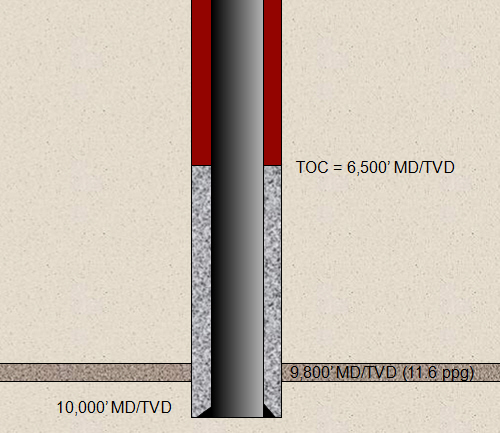
 cement Transition Period

Continue reading

How To Perform Volumetric Well Control Method

This article will demonstrate how to perform volume metric well control. There are a total of 5 steps as listed below;

146 How To Perform Volumetric Method 0

Step 1 – Calculation

Three calculations must be determined before conducting volumetric well control.

1. Safety Factor (SF) – The Safety Factor (SF) in an increase in bottom hole pressure which we allow to happen naturally when gas influx migrates up with the shut in well. SF is important because it will allow the bottom hole pressure to be over formation pressure so the well is not in underbalance condition while conducting later steps. Typically, SF is around 50 – 200 psi. If the initial shut in casing pressure is very close to maximum allowable surface pressure. Personnel must select small safety factor to prevent fracturing formation.

2. Pressure Increment (PI) – It is pressure used as a working pressure while conducting Volume Metric well control. This pressure will be equal amount of hydrostatic pressure of mud bled during each step.

3. Mud Increment (MI) – It is volume of mud bled off from the annulus to reduce hydrostatic pressure by amount of Pressure Increment. It is very important that the rig must have an accurate measurement to measure small amount of mud bled from annulus. Mud Increment is determined by the following equation:

 146 How To Perform Volumetric Method - MI

Where;

Mud Increment is in bbl.

PI is pressure increment in psi.

ACF is annular capacity factor in bbl/ft

MW is mud weight in ppg.

Continue reading

Volumetric Well Control – When It Will Be Used

Volumetric well control method is a special well control method which will be used when the normal circulation cannot be done. It is not a kill method but it the method to control bottom hole pressure and allow influx to migrate without causing any damage to the well.

volumetric

There are several situations where you cannot circulate the well as follows:

• Pumps broken down

• Plugged drill string/bit

• Drill string above the kick

• Drill string is out of the hole completely

With the volumetric method, the volume of gas influx will allow migrating and casing pressure will increase till a certain figure then a specific amount of mud will bleed off to compensate the increase in casing pressure. The volumetric method will allow the kick to surface while the bottom hole pressure is almost constant. Successful use of volumetric method requires personnel understand three basic concepts – Continue reading

Ram Preventers as Well Control Equipment

In the previous topic, we discuss about the annular preventer and today we would like to give you more details regarding ram preventers. The ram preventers were invented by James Smither Abercrombie and Harry S. Cameron in 1922.

This preventer consists of two rams which extend into the center of the wellbore in order to shut the well in (see the image below). The ram preventers can be hydraulically or manually operated. When people would like to shut the well in using the ram preventer, they will go to the hydraulic option first. If the hydraulic is not properly operated, the manual system will be utilized.

In order to provide the wellbore sealing, the rams must compose of top seals and packers which are made of the special elastomer. For more understanding, please take a look at the diagram of Cameron BOP below.

(Courtesy of Cameron)

When the well is shut in, the packer will seal around drillstring or tubular and the top seal will be pushed against the BOP body. With both top seals and packer, the well is securely shut in when

In the drilling industry, there are four types of rams preventers which are Pipe Rams, Variable Bore Rams (VBR), blind rams and blind-shear rams.

Continue reading