Importance of Choke Drill and Its Procedure

Choke drill is one of well control drills that will improve crew competency in driller’s method. The advantages from the choke drill are as follows:

• Get more familiar to practice controlling the pressure via a choke on the rig

• Get more understanding about lag time

• Practice the procedure to obtain the shut-in drill pipe pressure

• Ensure the surface well control equipment as pressure gauges, choke, BOP is ready for work

• Get more practices when attempting to bring the pump up to kill speed, slow the pump down and change the pump rate

Choke Drill Steps are listed below:

1. Trip in hole above top of cement

2. Fill the pipe and circulate seawater or mud around for few minutes

3. Close annular preventer or upper rams preventer

4. Pressure up annulus to 200 psi (the pressure may be different depending on the company policy.)

5. Line up the pump

6. Pump slowly to bump the float and obtain shut in drill pipe pressure

7. Bring the pump to kill rate by holding casing pressure constant – personnel need to adjust the choke

8. Measure lag time for the drill pipe gage after the adjustment of choke is made.

9. Change circulation rate by holding casing pressure constant. Crew needs to adjust choke to achieve this.

10. Shut the pump down by holding casing pressure constant.

11. Bleed off pressure and line up for drilling operation

Reference book: Well Control Books

Do you have too much slug in the well?

Slug is heavy drilling mud that is used to pump when you want to pull pipe dry. However, excessive volume of slug in the well can create higher mud weight and cause the problem. Today I would like to share my experience regarding slug in the well.

The situation happened on the drilling rig like this.

The well was TD with 13.0 ppg mud and circulation was conducted until the shale shakers. After that we pull 10 stands wet and pumped 40 bbl of 15.0 ppg slug and came out of hole without any problem. Then we run the logging and we got stuck. We picked the fishing gear and grabbed the fish. We pulled out 10 stands wet and hole was taking proper fill. We pumped same amount of slug 40 bbl of 15.0 ppg and came out of hole. The decision was made by town to trip in hole to do the wiper trip.

Tripping was done with caution and break circulation was conducted every 3000 ft to break the gel. Prior to TD 100 ft, we made up top drive and slowly washed down to TD. While we were circulating, the mud weight out was varied from 13.2 ppg to 14.2 ppg. Additionally, we start losing mud while circulating.

Do you know what went wrong?

The two slugs in the well cause us trouble.

Continue reading

Oilfield Funny – I Know You Will Love It

I have collected some oilfield funny pictures which will make you laugh. The latest update on 18-Jan-15

New design of offshore rig

New_Rig2

Oilfield Career in Different Functions in the Oilfield.

cute oilfield cartoon

Petroleum engineer

petroleum engineer

Chinese gas detector – Look at the picture. It seems like the driller close to the rotary table more than the chicken.

This is how oil and gas occur under the ground.

My salary

1458421_10152059376755926_836794914_n

What will happen if you left school?

left school

Continue reading

Pressure Drop Across a Bit

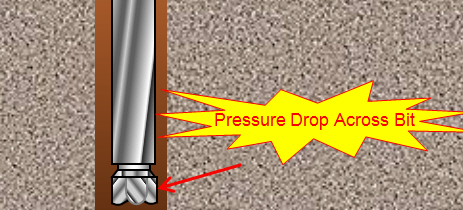
Pressure across a bit occurs when the drilling mud passing through the jet nozzles. This pressure drop is important for drilling hydraulic optimization (maximum hydraulic horse power or impact force) and hole cleaning. The pressure drop at the nozzle area is a function of total flow area of the bit, flow rate and mud density.

Pressure drop across the bit can be determined by the following equation:

Oilfield Unit

Pb = (Q²×W) ÷ (12031 × A²)


Where:

Pb = pressure drop across a bit, psi

Q = flow rate, gpm

W = mud weight, ppg

A = total flow area, square inch

Please use the following information to determine pressure drop across a bit

Flow rate = 800 gpm

Mud weight = 9.0 ppg

Total Flow Area = 0.3728 square inch

Pb = (800²×9.0) ÷ (12031 × 0.3728²)

Pb = 3,446 psi

Metric Unit

Pb = (Q²×W) ÷ (7.191 × A²)

Where:

Pb = pressure drop across a bit, KPa

Q = flow rate, lpm

W = mud weight, kg/m³

A = total flow area, mm²

Please use the following information to determine pressure drop across a bit

Flow rate = 3,000 l/m

Mud weight = 1,100 kg/m³

Total Flow Area = 240 mm²

Pb = (3,000²×1,100) ÷ (7.191 × 240²)

Pb = 23,901  KPa

The new version of spreadsheet can be downloaded by clicking the image below. 

Ref books: 

Lapeyrouse, N.J., 2002. Formulas and calculations for drilling, production and workover, Boston: Gulf Professional publishing.

Bourgoyne, A.J.T., Chenevert , M.E. & Millheim, K.K., 1986. SPE Textbook Series, Volume 2: Applied Drilling Engineering, Society of Petroleum Engineers.

Mitchell, R.F., Miska, S. & Aadny, B.S., 2011. Fundamentals of drilling engineering, Richardson, TX: Society of Petroleum Engineers.

Critical Flow Rate – Drilling Hydraulics

Critical flow rate is the flow rate at the transition point between laminar and turbulent flow. The first step of the critical flow rate determination is to figure out the critical velocity and then substitute it into the annular flow rate.

To get the point at the transition period, the critical Reynold Number for laminar flow must be around 3470 – 1370na. With this relationship, we can determine the critical velocity by rearranging the Reynold Number and Effective Viscosity equation.

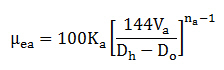
The effective viscosity equation for critical velocity is listed below:

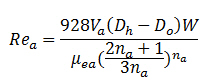
The Reynolds number equation for critical velocity is listed below:

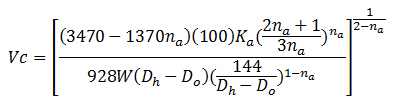
The critical annular velocity equation is listed below:

Continue reading