Overburden Stress Shale Causes Stuck Pipe

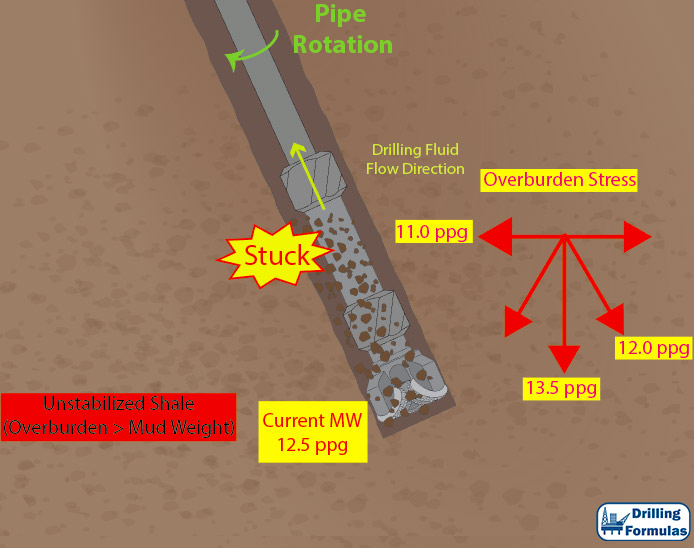
Overburden stress increases over depth (the more a well is drilled, the more overburden stress will be seen). When mud weight is not enough to support the overburden, the stress from the overburden will create shale fractures, which will then fall down into the wellbore. Finally, shale fractures will pack the wellbore and cause a stuck pipe incident,
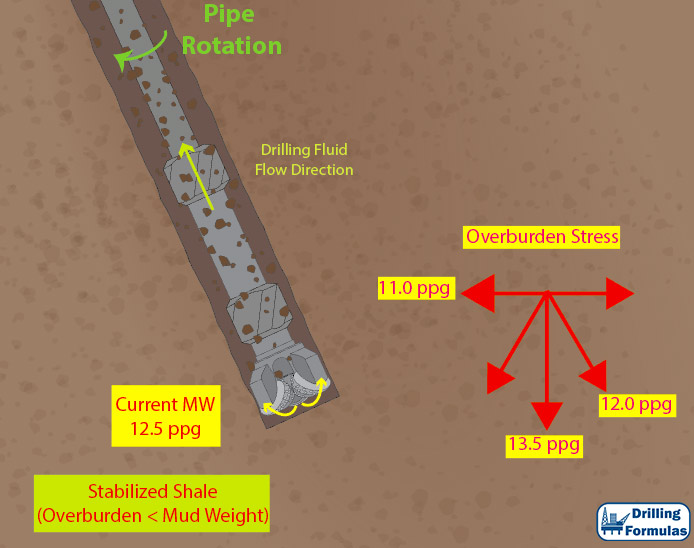
Mud weight is high enough to overcome overburden stress.
Mud weight is high enough to overcome overburden stress.

Mud weight is not high enough to overcome overburden stress.

Mud weight is not high enough to overcome overburden stress.

Warning signs of overburden stress shale

• Torque and drag increase.

• Pump pressure increase.

• Abnormal amount of shale at shale shakers

• Caving shape of shale at shakers

Indications when you stuck due to overburden stress shale

• It could  happen either while tripping or drilling (most likely while drilling).

• When it happens, the hole may be completely packed off or bridged off; therefore, circulation is very difficult or impossible to establish.

What should you do for this situation?

1. Attempt to circulate with low pressure (300-400 psi). Do not use high pump pressure because the annulus will be packed harder and you will not be able to free the pipe anymore.

2. If you are drilling or POOH, apply the maximum allowable torque and jar down with the maximum trip load.

3. If you are tripping in a hole, jar up with the maximum trip load without applying any torque.

4. Attempt until the pipe is freed and circulate to clean wellbore.

 Preventive actions:

1. Use drilling mud that is heavy enough to stabilize overburden stress.

2. Weight up the mud prior to drilling into stressed shale zones.

References

John Mitchell Drilbert Engineering, 2002. Trouble-Free Drilling Volume 1: Stuck Pipe Prevention. Edition. Drilbert Engineering Inc.

Fanarco.net. 1999. Stuck Pipe Prevention Self-Learning Course. [ONLINE] Available at: http://www.fanarco.net/books/drilling/stuck-pipe.pdf. [Accessed 21 June 2016

Steve Devereux, 2012. Drilling Technology in Nontechnical Language, 2d Ed.. 2 Edition. PennWell Corp.

Geo-Pressured Shale Causes Stuck Pipe

Pore pressure in shale is more than hydrostatic pressure; however, the well does not flow because shale is impermeable. While drilling through pressured shale formation, pressure in shale causes fractures of shale due to stress cracks.

Pressure in shale causes fractures of shale due to stress cracks.

Pressure in shale causes fractures of shale due to stress cracks.

Shale finally falls into the well and results in stuck pipe incident.

Geo-Pressured-Shale-Causes-Stuck-Pipe-2

Shale falling into the well.

Continue reading

Hydro-Pressured Shale Causes Stuck Pipe

Hydro-pressured shale is a common problem in some areas where shale become unstable under period of time. With mud weight in the wellbore higher than formation pressure, the pore pressure of shale is always charged by hydrostatic pressure from drilling mud.

Charged pressure due to hydrostatic pressure

Shale is charged by hydrostatic pressure.

When the well has been drilled for a period of time, shale formations become unstable due to charged pressure and finally shale breaks apart and falls down into the hole.

Shale becomes unstable.

Shale becomes unstable.

Then, a drill string gets stuck due to hydro-pressured shale which has accumulated in the annulus.

Pipe becomes stuck by unstable shale.

Pipe becomes stuck by unstable shale.

This process is time dependent just like shale instability. It may take days before the stuck pipe situation will occur.

Warning signs of hydro-pressured shale:

• Torque and drag increase.

• Over pull may be observed.

• Observe shale caving in on shale shakers

 Indications when you stuck due to hydro-pressured shale:

• When it happens, the hole will be either partially bridged off or packed off; therefore, circulate is restricted or impossible in some cases.

• It could happen while tripping and drilling.

What should you do for this situation?

1. Attempt to circulate with low pressure (300-400 psi). Do not use high pump pressure because the annulus will be packed harder and you will not be able to free the pipe anymore.

2. If you are drilling or POOH, apply the maximum allowable torque and jar down with the maximum trip load.

3. If you are tripping in a hole, jar up with the maximum trip load without applying any torque.

4. Attempt until the pipe is freed and circulate to clean the wellbore.

Preventive actions:

1. Use oil based mud instead of water based mud because oil will not react with shale.

2. Minimize surge pressure and equivalent circulating density (ECD) in the wellbore.

3. Keep mud properties in good shape. Avoid drilling and circulating with thick mud because it creates additional surge pressure.

References

John Mitchell Drilbert Engineering, 2002. Trouble-Free Drilling Volume 1: Stuck Pipe Prevention. Edition. Drilbert Engineering Inc.

Fanarco.net. 1999. Stuck Pipe Prevention Self-Learning Course. [ONLINE] Available at: http://www.fanarco.net/books/drilling/stuck-pipe.pdf. [Accessed 21 June 2016

Steve Devereux, 2012. Drilling Technology in Nontechnical Language, 2d Ed.. 2 Edition. PennWell Corp.

A Dictionary For The Oil And Gas Industry Review

As new personnel in the oil field, you may be struggle of many wordings and terminologies of this industry. The better way to learn meaning of petroleum industry is to use a special dictionary. Today I would like to recommend you the oil filed dictionary named “A Dictionary For The Oil And Gas Industry” which is published by the University of Texas at Austin.


Why is this book good?

• The dictionary of petroleum has e a lot of useful oilfield terms which is over 11,000 words and slangs.

• The terms contained in the book come from wide range of professionals in the industry as reservoir engineering, production engineering, geologist, geophysics, drilling and completion, law, marine engineering, etc.

• It is very good especially new personnel in the petroleum industry. It will make the life a lot easier when taking with people in oil field term.

• There are a lot of neat images which will help people fully understand what they are looking for. I just take a sample photo of this dictionary as you can see at the image below.

• Even though you are experienced hand, you may not know everything like me. This book is good for reference for experienced people as well.

• Not only are there tons of petroleum words, but there are also a lot of oil field abbreviations.

Where to buy it?

Amazon offers good price and delivers it word wide. Please check it out.

A Recommended Unit Conversion Program

Many people asking me about the unit conversion because all of drilling formulas showing in the website and the drilling formula spread sheet are in oil field unit. It creates some hassles to some people. I wish I could convert all formulas into Metric unit but I have no time. Therefore, the simplest solution is to use a unit conversion program.

This is the unit conversion program created by Josh Madison. These are some screenshots of this program.


This unit conversion program is totally free and very easy to use. It will convert the most popular units such as distance, temperature, volume, time, speed, mass, power, density, pressure, energy and many others.

This is the screen of this program once you open it.


There are several units as you can see on the screen shot shown below.


For example, if I want to convert a flow rate of 250 gpm in to liters/minute, I just select flow and input 250. The result is 946.35 liters/minute.


This program is so simple to use and I am 100% sure that it will help you do your job.

You can download via this link= >.