Cement Blocks Causes Stuck Pipe

Cement around a casing shoe or open hole cement squeeze becomes unstable and finally, chunks of cement can fall into a wellbore. If there are a lot of cement chunks in the annulus, the drilling string will get stuck.
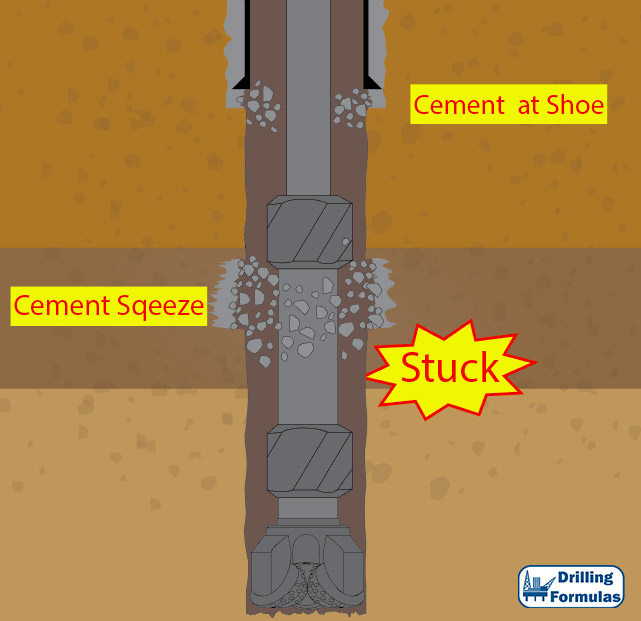
Cement Blocks

Cement Blocks

 Warning signs when you get stuck due to Cement Blocks

• Rat hole is too long.

• Drilling into areas where open hole cement jobs as cement squeezes or kick off plug was performed.

Stuck identification for Cement Blocks

• Cement chunks are seen at shale shakers.

• There is cement content in mud logger samples.

• Stuck pipe due to cement blocks can  occur anytime.

• Circulation is not restricted.

• Torque and drag are drastically increased and erratic.

What should you do for this situation?

1. Stuck while moving up, jar down with the maximum allowable trip load. Gradually apply torque if required.

2. Stuck while moving down, jar up without applying torque.

3. Pump weighted hi-vis sweep with maximum allowable flow rate to clean large pieces of cement from around drilling string/BHA.

Preventive actions:

1. Do not leave a long rat hole.

2. Ream with circulation through casing shoe and areas where there is open hole cement.

3. Attempt to clean cement in the annulus prior to drilling.

4. Wait long enough for the cement to set before drilling ahead.

5. Minimize tripping speed when BHA passes through casing shoe or cement plug/cement squeeze depth.

References

John Mitchell Drilbert Engineering, 2002. Trouble-Free Drilling Volume 1: Stuck Pipe Prevention. Edition. Drilbert Engineering Inc.

Fanarco.net. 1999. Stuck Pipe Prevention Self-Learning Course. [ONLINE] Available at: http://www.fanarco.net/books/drilling/stuck-pipe.pdf. [Accessed 21 June 2016

Steve Devereux, 2012. Drilling Technology in Nontechnical Language, 2d Ed.. 2 Edition. PennWell Corp.


I Need Your Help

Today, we are discussing about the contents that we will add into drillingformulas.com and there are a lot of topics that we can think of. However, we don’t have enough time to write all topics; therefore I need your help.

Would you mind suggesting us which topics that you would like us to share in drilllingformuals.com?

The topic can be anything that you can think of such as

Well control

Hydraulic

• Economics

Drilling operation

Oilfield book review

Drilling engineering calculations

• etc

With your valuable input, we will do the best to share the valuable content regarding drilling knowledge to you for free.

Please feel free to reply us in the blog, facebook, twitter or email (for subscription member).


Fractured Formation Causes Stuck Pipe

While drilling into naturally fractured formations, pieces of formations fall down in the annulus and can cause a stuck drill string.

fracture-formation-cause-stuck-pipe

Stuck pipe by naturally fractured formation

Warning signs when you get stuck due to Naturally Fractured Formation

• Drill into potential naturally fractured zones as limestone, sand stone, carbonate, etc.

• Observe big caving formations on shale shakers while drilling

• Observe volume to fill the hole is more than a normal hole size

 Stuck identification for Naturally Fractured Formation

• This situation can  occur during drilling or tripping.

• Torque and drag are suddenly changed and erratic while drilling.

• Over pull off slip is noticed.

• Circulation could be restricted (you may get or not get good circulation)

What should you do for this situation?

1. Stuck while moving up, jar down with the maximum allowable trip load without applying any torque!!!

2. Stuck while moving down, jar up without apply torque

3. Pump weighted hi-vis sweep with the maximum allowable flow rate

 Preventive actions:

1. Keep mud in good shape. Good and thin mud cake can support fracture formation in some cases.

2. If the suspected zones are drilled, you should take the time to circulate the hole clean before making headway.

3. Start and stop circulation slowly to minimize surge pressure.

4. Work pipe with restricted speed to prevent surging formations.

5. Tripping speed should be slow while BHA is being run into suspected zones.

6. The fractured formations require time to get stabilized.

References

John Mitchell Drilbert Engineering, 2002. Trouble-Free Drilling Volume 1: Stuck Pipe Prevention. Edition. Drilbert Engineering Inc.

Fanarco.net. 1999. Stuck Pipe Prevention Self-Learning Course. [ONLINE] Available at: http://www.fanarco.net/books/drilling/stuck-pipe.pdf. [Accessed 21 June 2016

Steve Devereux, 2012. Drilling Technology in Nontechnical Language, 2d Ed.. 2 Edition. PennWell Corp.

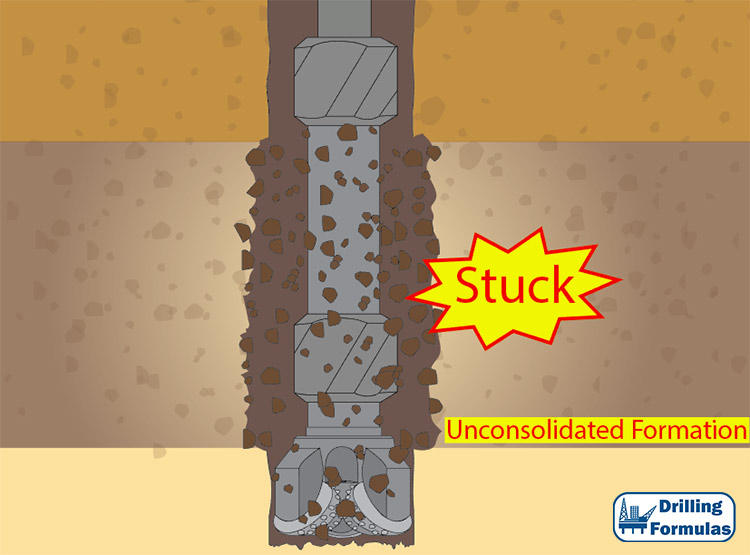
Unconsolidated Formation Causes Stuck Pipe

This situation could happen when drilling into unconsolidated formations such as gravel, sand, pea, etc. Since bonds between particles are weak, particles in the formations will separate and fall down into the hole. If there are a lot of unconsolidated particles in the annulus, the drilling string can possibly be packed off and stuck.

unconsolidated-formation

 Warning signs when you get stuck due to unconsolidated formation

• This situation could happen either while drilling or tripping. There is more of a chance that the situation can happen while drilling.

• Slight loss may possibly be seen while drilling.

• Drilling torque and pump pressure abnormally increases.

• Abnormal drag can be observed while picking up a pipe.
Indications when you are stuck due to unconsolidated formation

• Observe a lot of particles of gravel, sand, pea over shale shakers.

• Increase in mud weight, rheology and sand content in drilling mud.

• When it happens, the annulus may be completely packed off or bridged off; therefore, circulation is very difficult or impossible to establish.

• Most of the time this situation happens while drilling a surface section where formation bonding is not strong. Moreover, it can occur suddenly.

What should you do for this situation?

1. Attempt to circulate with low pressure (300-400 psi). Higher pump rate is not recommended because it will cause more cutting accumulation around a drill string and your drill string will become harder to get free.

2. If you are drilling or POOH, apply the maximum allowable torque and jar down with the maximum trip load.

3. If you are tripping in a hole, jar up with the maximum trip load without applying any torque.

4. When the pipe is freed, circulate to clean wellbore prior to drilling ahead.

Preventive actions:

1. Use high vis/weight sweep to help with hole cleaning.

2. Ensure that fluid loss of drilling mud is not out of specification. Good fluid loss will create good mud cake, which can help seal the unbounded formation.

3. Control ROP while drilling into unconsolidated zones and take the time to clean the wellbore if necessary.

4. Slow tripping speed when BHA is being passed unconsolidated zones to minimize the formation falling down.

5. Minimize surge pressure by starting/stopping pumps slowly and working the string slowly.

6. Spot gel across suspected formations prior to tripping out of a hole. Gel could prevent some particles from falling down into the wellbore.

References

John Mitchell Drilbert Engineering, 2002. Trouble-Free Drilling Volume 1: Stuck Pipe Prevention. Edition. Drilbert Engineering Inc.

Fanarco.net. 1999. Stuck Pipe Prevention Self-Learning Course. [ONLINE] Available at: http://www.fanarco.net/books/drilling/stuck-pipe.pdf. [Accessed 21 June 2016

Steve Devereux, 2012. Drilling Technology in Nontechnical Language, 2d Ed.. 2 Edition. PennWell Corp.

A Premier Of Oil Well Drilling Review

A Primer of Oilwell Drilling: A Basic Text of Oil and Gas Drilling

For new persons who don’t have much idea about drilling, A Primer of Oilwell Drilling is a good book to start with. The wording in the book is written in a simple way so people can read and understand details regarding a drilling business.

The book covers every aspect of basic drilling knowledge and what people will learn from this book is listed below:

• History of rotary drilling

• Cable tool and rotary drilling

• Rig types (land and offshore rig)

• People involving in drilling industry

• Basic of geology as how oil and gas occur, hydrocarbon reservoirs, type of wells, etc.

• Drill site – how to select the drill site and how to manage the drill site

• Rig component, power system, hoisting system, etc

• Basic drilling operations such as drilling, tripping, running completion, circulating, cementing, etc

• Formation evaluation – wire line logging, mud logging, drill stem test, coring

• Completion basic – setting production casing, perforating, running tubing, etc

• Safety on the drilling rig.

Continue reading