J-Lay Pipeline Installation

J-Lay pipeline installation method is frequently used in deep water pipeline installation. The curvature of pipe line is similar to J shape (Figure 1) while the subsea pipeline is being installed. J-Lay method can handle a full range of pipeline size and it is particularly suitable for deep water pipeline installation up to 2,000 m (6,560 ft).  Furthermore, the J-Lay method can withstand higher underwater current and sea state than the S-Lay method.

The J-lay method puts less stress on the pipe line because the pipeline is installed in an almost vertical position. Whereas the S-lay method puts on more stress due to two curvatures at the sag bend and over-bend region. The pipeline is sent into water at a small angle reference to a vertical line and continues at a steep angle until a sag bend is formed.

Figure 1- J-Lay pipeline vessel

Figure 1- J-Lay pipeline vessel

This works very well in deep water environment where distance from a vessel to a touchdown point is quite far because sag bend is not too much. If the short distance from a vessel to a touchdown point. Continue reading
Pipe Line S-Lay Method

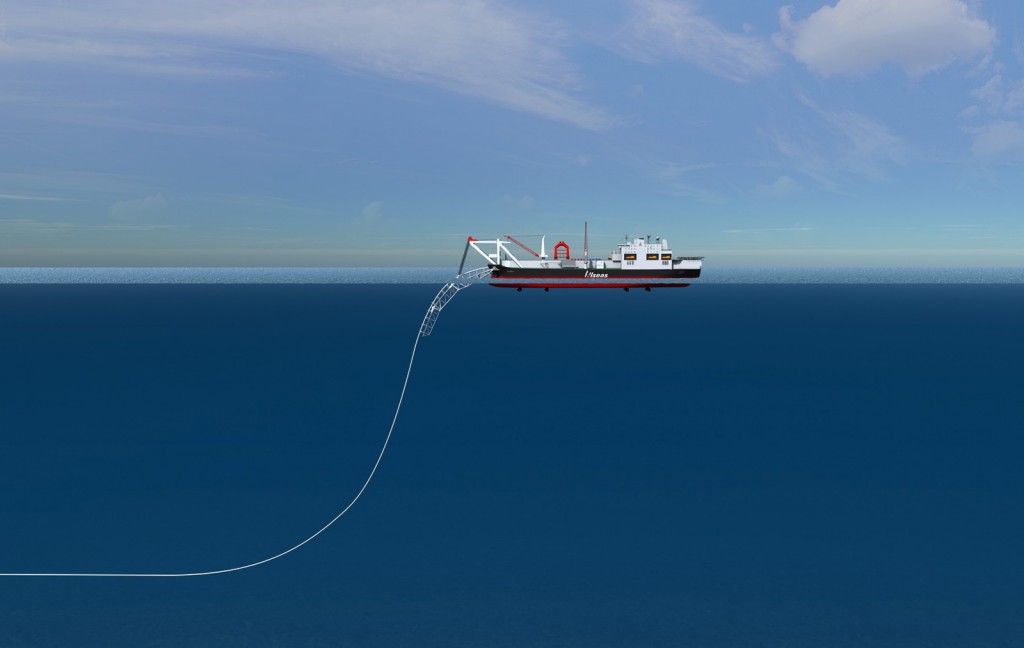
S-lay method is the oldest and the most commonly used method for offshore pipeline installation. This is named as “S-lay” because the shape of the pipe line while being installed looks like S-shape (Figure 1).

Figure 1 – S-Lay Method (Courtesy of Allseas) 

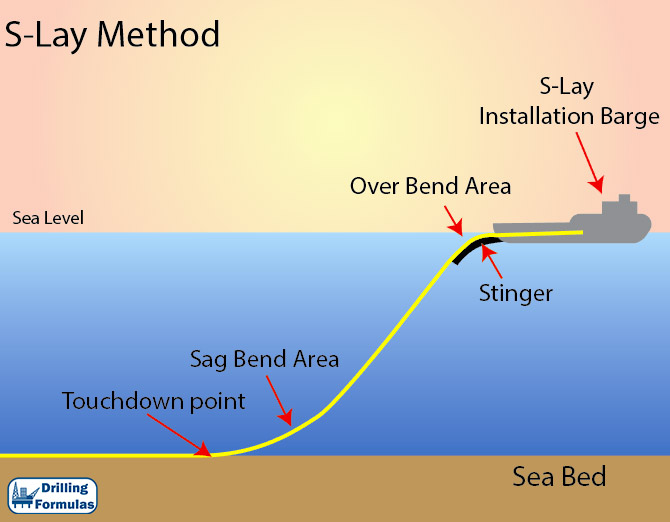
While installing pipe line using S-lay method, the pipe line is eased off the stern of a pipeline installation boat as the vessel moves forward. The pipe line is transferred into the sea until it reaches the sea bed which is called the “Touch down poin.t. Each joint of pipe line is welded on the installation vessel and eased off the boat. A stringer located at the stern, whose length can be up to 300 ft., helps supports the pipeline when it is transferred into the sea. Some installation barges can be equipped with an adjustable stringer which is used to control the length of a stringer. This stinger is vulnerable to damage in bad weather.

Figure 2 - S-Lay Diagram

Figure 2 – S-Lay Diagram

Continue reading

Perforation Fundamentals – Basic Knowledge about Perforation Used in Oil and Gas Industry

Perforation is a special operation to crease an efficient communication path between a wellbore and a reservoir by creating tunnels. The effective paths allow reservoir fluid to flow into the well with minimum pressure loss (less skin as much as possible).

Perforation (Courtesy of Schlumberger)

Perforation (Courtesy of Schlumberger)

The process of perforation involves lowering a perforating gun into a wellbore to a planned depth and energizing the gun to be safely fired. When perforating a well, shape charges are fired and then energy from the explosion will create tunnels through casing, and cement and then into a reservoir. Length and diameter of perforation hole are dependent on the objectives which will be discussed later. Figure 1 shows the cross sectional of perforation.

Figure 1 – Perforation Cross Section Ref:http://www.angelfire.com/wy/lisadenke/pictures/assorted_facts_pics/HES_perfs.gif

Continue reading

Useful Oilfield E-book That You Can Download Them for Free

This post will give you the guideline about the useful oilfield ebook that you can download it for free. There are variety of subjects which you may have a look in the following details;


Project Management for the Oil and Gas Industry Free-E-Book---Project-Management-for-the-Oil-and-Gas-Industry

Project Management for the Oil and Gas Industry A World System Approach written by Adedeji B. Badiru and Samuel O. Osisanya is one of the best project management books/e-books in oil and gas industry.

Upstream Oil & Gas Overview SlidesUpstream-Oil-&-Gas-Overview-Slides

IOM3 (The Institute of Materials, Minerals and Mining) share another good presentation about upstream oil and gas overview. This is an excellent document which will help people understand more about oil and gas industry. Continue reading

Tubular Material Selection for HTHP Well with Example Calculation

This article demonstrates how to select material that will be suitable for high pressure, high pressure and corrosive environment. The material chart is based on the Sumitomo tubular chart.

HTHP-selection-cover

Well conditions are as follows;

Reservoir: High pressure & high temperature gas reservoir

Reservoir Temperature: 420 F (216 C)

CO2 content: 2.9% mol

H2S:40 ppm

Chloride Ion Content in Produced Water: 150,000 ppm

Fluid saturation pressure: 10,000 psig Continue reading