Shape of the Earth and Geodetic Datums for Directional Drilling

Directional drilling relies on mapping system to accurately identify location of the wells. Therefore, it is very important to learn the basics of mapping and other relevant information. This topic is about Geodetic Datum.

The Earth is not a complete sphere shape but it is actually Oblate Spheroid (“Spheroid”). It means that the shape of the Earth is almost a sphere. It can be proven from the fact that the equatorial diameter (the longest diameter) is approximately 12,756 km and the diameter from the North Pole to the South Pole is approximately 12,714 km (Figure 1). Additionally, the Earth has a different attitude based on location. So, people developed a model to help describe the Earth, which is called “Geodetic Datums”.
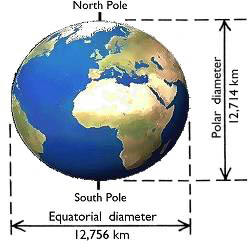
Figure 1 - Earth Shape

Figure 1 – Earth Shape

Continue reading

Overview of Slips and Elevator Used in Upstream Drilling Industry

This article will explain the overview of slips and elevator which are very important tool on the rig.

Slips

Slips are wedge-shaped gripping devices which are used to suspend the drill string in the hole. They fit around the body of drill pipe and wedge in the taper of the rotary table’s opening. Slips have serrated inserts or dies that will grip the outside diameter of the tubular when it is set on the rotary table. To set the slips, rig crews place them around the pipe and the driller then slowly lowers the pipe until the slips can take up the load. The dies in the slips will firmly hold the pipe. In order to remove the slips, rig crew grasp the slip handles and as the driller picks up the pipe, they lift them out of the rotary table opening and set them aside.

You can watch this video to see how the rig crew set and remove the slips

  Continue reading

Solid Content in Drill Mud

Solid content is a fraction of the total solid in drilling mud, and it always increases while drilling ahead because of drilling solid (cuttings), mud chemical additives and weighting material. Solid content refers to soluble and insoluble solid content in the drilling fluid system.

solid-content-in-mud

There are three types of solid contents as listed below;

Soluble material such as salt
Insoluble high gravity solid (HGS) such as weighting agents (barite, calcium carbonate, hematite, etc.)
Insoluble low gravity solid (LGS) or drilled solid such as solids particles from cuttings

Continue reading

Mud Filter Cake

Mud filter cake is a layer formed by solid particles in drilling mud against porous zones due to differential pressure between hydrostatic pressure and formation pressure.  For the drilling operation, it is preferred to have a filter cake that is impermeable and thin. Practically, the filter cake from API or HTHP fluid loss test should be less than or equal to 1/16 inch. If drilling fluid is not in a good shape, which results in a thick filter cake in the wellbore, it will lead to a stuck pipe situation and high torque/drag.

Mud filter cake

Mud Filter Cake from HTHP Fluid Loss Test (http://oilfieldpix.com/photo/679/Mud-filter-cake.html)

Continue reading

Determine Quantity of Material Used in Mixing a Simple Drilling Mud

This is a simple example to demonstrate how to determine quantity of material required in a simple mixing system. Let’s learn from the example below.

The objective is to build mud which has a weight of 11.0 ppg with 1,000 bbl.

The mud recipe is shown below;

  • 30 ppb bentonite
  • 5 ppb CMC polymer
  • 5 ppb caustic soda (NaOH)
  • 25 ppb Na2CO3
  • Weighting Material is barite.

The following are important data of water and chemical used for this calculation.

Base fluid = fresh water

Specific gravity of water = 1

Specific gravity of barite = 4.2

Specific gravity of bentonite = 2.4

Specific gravity of CMC polymer = 2.4

Fresh water weight = 8.34 ppg

NaOH and Na3CO3 have negligible volume because it is dissolvable.

What is quantity of material required to meet the mud specification?

What is the final volume? Continue reading