Kick Scenarios in Horizontal Wells For Well Control

Drilling horizontal wells are always in the development phase and people know the geological area pretty well. Additionally, they can accurately determine reservoir pressure of the target sand for the horizontal candidate. Hence, drilling engineers can plan the well with less chance of being underbalance condition. However, there are several scenarios where the well control occurs in horizontal wells. We will need to understand what circumstances can create well control situations in the known well bore pressure like the horizontal wells.

 kick-Scenarios-in-Horizontal-Wells-cover

Swabbed Kick

The swab in the horizontal wells is similar to swabbing in normal well. Swabbing effect can occur when the pipe is pulled off bottom for making up connection or when tripping out of hole. High rate of swab entering into the well can happen if swabbing occurs when tripping out of the hole. The length of horizontal section will be exposed to the differential swab pressure. On the other hand, the swab will be small when the pipe is pulled off bottom for making connection. In this case, you may see several small gas behind the bit which will show on the surface later. Continue reading

Introduction To Well Control for Horizontal Wells

Currently, horizontal wells are widely drilled around the world because the production from the horizontal  wells is outperform normal vertical or deviated wells at the same location. The productivity of the well increases because of longer penetration into a pay zone and/or more intersection of reservoir fractures (see Figure 1) .

 Introduction To Well Control for Horizontal Wells 1

Figure 1: A normal well and a horizontal well

Well control for the horizontal wells has the same fundamental principle during the circulation of influx from the well.  There are some corrections which adjust for frictional pressure between true vertical depth and measure depth since the horizontal wells usually have very long depth in comparison to wellbore true vertical depth.

Introduction-To-Well-Control-for-Horizontal-Wells-cover

Driller’s method is a preferred method for horizontal well control because it does not require drill pipe pressure schedule. Personnel can start circulate the first circulation to remove kick and displace the well with kill weight fluid using the second circulation method. However, if Wait and Weight method is planned to used, personnel should use a well control kill sheet with horizontal well feature to simulate the profile. It is very difficult to determine drill pipe schedule because there are several factors associated with calculations as well bore profile, size of pipe, hole size, etc. Continue reading

Driller’s Method or Wait and Weight Method – What is The Practical Well Control Method for You?

Driller’s method and wait and weight method (engineer’s method) are widely used to circulate wellbore influx while maintaining bottom hole pressure constant. There are a lot of opinions regarding which method is the best for well control operation therefore this article will discuss about pros and cons of both methods.

driller-or-wait-and-weight-method

Driller’s Method

The driller’s method requires two circulations to kill the well. The first circulation is to circulate influx out of the well with original mud weight. The second circulation is to kill the well with kill weight fluid. During the first circulation, the bottom hole pressure remains constant due to maintain drill pipe pressure constant while circulating. For the second circulation, in order to maintain constant bottom hole pressure, casing pressure is held constant while circulating kill mud to the bit. Once the kill mud passes the bit, the drill pipe pressure will be held constant until the kill weight mud is on surface and there is no sign of influx in the annulus.

Wait and Weight Method

The Wait and Weight method requires only one circulation. The influx will be circulated out while the kill weight mud is displaced into the well simultaneously. While pumping the kill fluid from surface to the bit, drill pipe pressure schedule must be strictly followed. After that the drill pipe pressure is maintained constant until the kill mud returns back to surface.  Some people call the Wait and Weight method as “Engineer’s Method” because there are more calculations compared to the Driller’s method.

Comparison between Driller’s Method and Wait and Weight Method

Continue reading

Shut-In Procedure while Tripping with a Subsea BOP Stack

After we publish this article “Hard Shut-In Procedure while Drilling with a Subsea BOP Stack”, there are some people asking us about what about the shut-in procedure while tripping with a subsea stack. So today we will focus on this topic.

 shut-In-Procedure-while-Tripping-with-a-Subsea-BOP-Stack

For the shutting in procedure with subsea stack, there are 3 steps which are stab valve, space out, and shut in and the details for the procedure are below.

 1st step: stab valve

  • Stab the full opening safety valve into the string and then make it up to the drillstring. Close the valve.

Continue reading

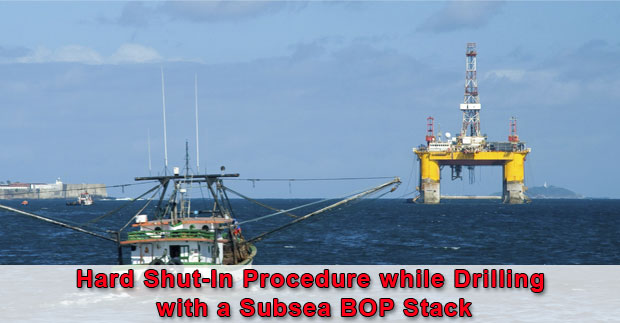
Hard Shut-In Procedure while Drilling with a Subsea BOP Stack

Nowadays, deepwater drilling is one of the important parts of drilling in the world and there are a lot of ongoing deepwater operations. Our team will start focus on subsea well control and this topic is about hard shut in procedure while drilling with a subsea stack. This is quite similar to surface stack but it is quite tricky how you space out the well properly because the BOP is way down below approximately thousand feet from sea surface.

Shut-In Procedure while Drilling with a Subsea BOP Stack

There are 3 steps which are space out, shut down and shut in and the details for the procedure are below.

1st step: Space Out

Continue reading