Fracture Gradient Reduction Due to Water Depth

Fracture gradient is one of the critical information which drilling engineers need to know in order to design drilling programs. For the well control stand point, the fracture gradient directly affects on how much influx volume can be successfully contained in the wellbore. If the wellbore pressure is over the fracture pressure, formations would be broken down and this situation will result in loss of drilling fluid into formations. Additionally, it might lead to well control situation because of loss of hydrostatic pressure. Fracture gradient is quite straight forward for land operation because it will not be reduce due to water column. However, the fracture gradient will be reduced in deepwater environment. In this article, we will discuss why water depth can cause the reduction in fracture gradient.

Fracture Gradient Reduction Due to Water Depth

Basically, the fracture gradient is related to fluids occupying in pore spaces of rock and weight of rock which are called overburden pressure. Generally, the overburden of a typical sedimentary is about 1.0 psi/ft (19.2 ppg). Rocks will be fractured when the wellbore pressure exceeds the confining stresses acting on it. If we make a general assumption that the overburden pressure causes the minimum confining stress of the rock. Then the formation fracture gradient will not be 1.0 psi/ft if the location is offshore.

Note: this assumption is made in order to help you get more understanding on how and why water depth can decrease the formation fracture gradient.

Why does the water depth reduce fracture gradient?

Continue reading

Bullheading Well Control Method

Bullheading is one of the well control methods which may be utilized in some occasions in order to control the well. Concept of bullheading is to pump kicks back into formations by using kill weight fluid. People usually use this method when normal circulation is impossible and volumetric method is not feasible to perform.

bullheading-Well-Control-Method-cover

When May You Consider Using the Bullheading Well Control Method?

  • When the kick size is very big so you may not be able to control the excessive volume coming to the surface.
  • When you need to reduce surface pressure in order to start further well control operations.
  • When there is a possibility to exceed surface pressure and volume gas on the surface if the conventional methods (drillers’ method, wait and weight and volumetric) are performed.
  • When there is no pipe in the hole while taking influx.
  • The influx contains high level of H2S which can cause safety of personnel on the rig.
  • When there is no feasible way to strip back to the bottom in order to kill in the flux below.

Continue reading

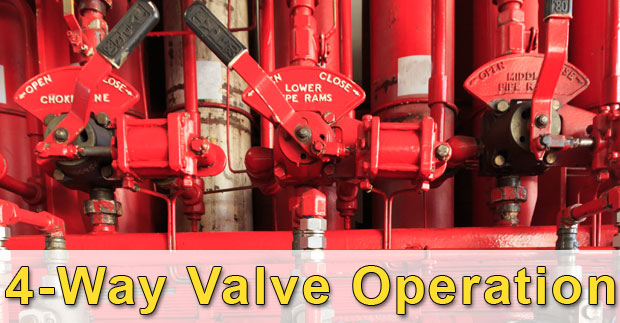
4-Way Valve Operation in Blow Out Preventer Accumulator (Koomey) Unit

4-way valves in the accumulator (Koomey) unit are used to control the position of Blow Out Preventer (BOP). Today we will go into the detail of 3 positions of 4-way vales in order to see how each position affects to the BOP.

4-way valve operation fb

Read more details about Koomey Unit here =>mechanism of Koomey unit.

Four-Way Vale in Open Position

When the valve is turned into the open position, it directs hydraulic pressure from the manifold into the BOP openning port therefore the BOP is in the open position. The hydraulic fluid in the ram closing chamber will return back to the reservoir tank. Figure 1 illustrates how the hydraulic pressure is lined up to open the BOP.

 4-way-vale-open-rams

Figure 1 – Open position of the 4-way valve

  Continue reading

Basic Understanding of Sub Sea BOP VDO Training

Sub Sea BOP is one of the most critical well control equipment in deep water drilling and it is a good topic for everybody working on the rig to learn.

Sub-sea-BOP-equipment-fb-size

Today, we would like to share a valuable VDO training regarding the basic of sub sea BOP. Additionally, we provides learner full VDO transcript to accelerate your learning curve.

Basic Understanding of Sub Sea BOP VDO Transcript

Subsea BOP equipment is similar to a surface stack. There are however some very important differences. This section discusses these differences.

Subsea stacks attached to the well head on the seafloor meanwhile the rig floats on the water hundreds of thousands of feet or meters above. Major parts include;

Continue reading