How Much Force Applied to a Rig Tong To Get The Right Torque at The Connection

One application of the rig tong is to use to make up connection. The question is asked about how to get the right torque value to the connection if you use the rig tong because you will not see the torque value on the gauge. This article will describe how to determine the correct force applied to get the correct torque value when you use the rig tong to make up the connection.


This formula below is used to determine force at required make up torque value.

rig-tong

Oilfield Unit

Force = Torque ÷ Length of the tong

Where;

Torque in ft-lb

Force in lb

Length of the tong in ft

Force is perpendicular to the tong length.

The illustration above demonstrates the direction of force.

Metric Unit

Force = Torque ÷ Length of the tong

Where;

Torque in N-m

Force in

Length of the tong in m

Force is perpendicular to the tong length.

Example:

Connection 4-1/2” IF – required make up torque = 30,700 ft-lb.

Tong length is 4 ft

rig-tong-example

How much pulling force do you require to achieve the required make up torque?

Force = Torque ÷ Length of the tong

Force = 30,700 ÷ 4.0

Force = 7,675 lb

Answer: 7,675 lb pulling force is applied to 4-ft tong in order to get the torque at connection at 30,700 ft-lb.

You can download the spreadsheet from the  download link.
Ref books: 

Lapeyrouse, N.J., 2002. Formulas and calculations for drilling, production and workover, Boston: Gulf Professional publishing.

Bourgoyne, A.J.T., Chenevert , M.E. & Millheim, K.K., 1986. SPE Textbook Series, Volume 2: Applied Drilling Engineering, Society of Petroleum Engineers.

Mitchell, R.F., Miska, S. & Aadny, B.S., 2011. Fundamentals of drilling engineering, Richardson, TX: Society of Petroleum Engineers.

Bullheading Well Control Method

Bullheading is one of the well control methods which may be utilized in some occasions in order to control the well. Concept of bullheading is to pump kicks back into formations by using kill weight fluid. People usually use this method when normal circulation is impossible and volumetric method is not feasible to perform.

bullheading-Well-Control-Method-cover

When May You Consider Using the Bullheading Well Control Method?

  • When the kick size is very big so you may not be able to control the excessive volume coming to the surface.
  • When you need to reduce surface pressure in order to start further well control operations.
  • When there is a possibility to exceed surface pressure and volume gas on the surface if the conventional methods (drillers’ method, wait and weight and volumetric) are performed.
  • When there is no pipe in the hole while taking influx.
  • The influx contains high level of H2S which can cause safety of personnel on the rig.
  • When there is no feasible way to strip back to the bottom in order to kill in the flux below.

Continue reading

Oil & Gas Well Casing – VDO Training

There are several articles discussing about casing design and we would like to share you this excellent VDO training in this topic “Oil & Gas Well Casing”. This VDO contains the basic over view of casing starting from surface to production section.  You will see nice illustrations which help you get clearer picture on this topic and we also add full VDO transcripts to provide assistance to some learners who cannot catch the content in this VDO clearly.

Oil & Gas Well Casing – VDO Transcript

oil-Gas-Well-Casing

By the time the crew drills the well to depth, it usually has several strings of casing in it. These strings are called conductor casing, surface casing, intermediate casing and production casing.

Notice that cased well looks something like a telescope pulled out of full-length but it is as the crew drills the well deeper, the size of the whole and the size of the casing gets smaller in diameter. Almost always, the drilling contractor cannot begin drilling at the surface and go all the way to total depth in one step.

Continue reading

Casing Size Selection – How To Select Casing Size to Match the Drilling and Completion Goal

We’ve learnt several topics in regard to casing design and this article will demonstrate you how to determine casing size in the well.

casing-size-selection-cover

Casing size selection is determined from the inside outward and it starts from the bottom hole.

The sequence of design is based on the following steps;

1. Proper sizing of tubing is determined by inflow performance analysis.

2. Completion equipment is planned to install with tubing string. Determine which part has the biggest OD. This will directly impact of production casing.

3. Bit size for drilling the production section.

4. Casing size must be smaller than bit size and its ID must be bigger than the biggest component in completion string.

5. Once you get the last casing string, the upper string is selected by repeating bit selection and casing selection similar to step #3 and #4.
Continue reading

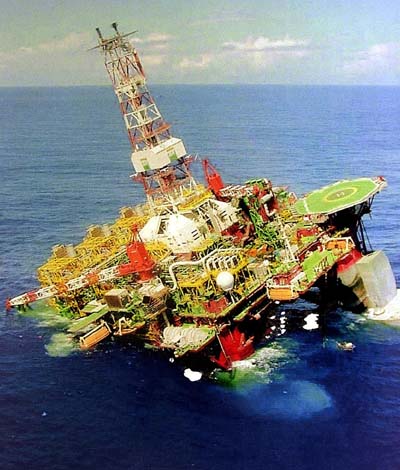
Petrobras P-36 Sinking – The Biggest Oil Rig Sinking In the Oilfield Industry

Petrobras P-36 – This incident cost several million us dollars and it’s worthy to learn from it. One of the biggest global floating semi-submersible oil platforms Petrobras 36 (P-36), which was owned by Petrobras, an oil company in Brazil with its base of operations at Rio De Janeiro was destroyed after 20th March 2011 when it sunk. The platform was then approximately valued at US$350 million. Its current value is US$466 million. Constructed and erected as a drilling rig in the year 1995, at the Fincantieri shipyard (Genoa, Italy), was owned by SocietàArmamentoNaviAppoggioS.p.A. The rig, which was a good 33,000 tonnes was transformed to the biggest global oil production platform by Davie Industry, Levis, Canada. P-36, which was functioning for Petrobras, about 130 kms off the coast of Brazil on the Roncador Oil Field daily generated approximately 84,000 barrels (13,400 m3) of crude oil. P-36 was substituted by a chartered vessel from SBM Offshore, FPSO-Brasil, which is in a lease contract with Petrobras since Dec 2002. Continue reading