Piston Force on Closed-Ended Tubular (Plugged Tubular)

According to the previous post (piston force on open-ended tubular), applied surface pressure will reduce tensile force on surface. In this article, this is an analysis on the piston force on a plugged tubular string and the details are shown below;

Tubing Detail

  • 5” Tubing
  • ID of tubing = 3.696”
  • Packer seal bore OD = 5.25”
  • Weight per length = 17.7 lb/ft
  • Total Length = 10,000 ft
  • Plugged tubing depth = 10,000 ft
  • Fluid density = 10 ppg
  • Tubing is free to move in the packer
  • Applied surface pressure = 5,000 psi

Figure 1 shows the wellbore schematic. Applied pressure (5,000 psi) will cause a piston effect to push the tubing. Therefore, at the bottom of tubing buoyancy and piston force will act in an upwards direction (compression).
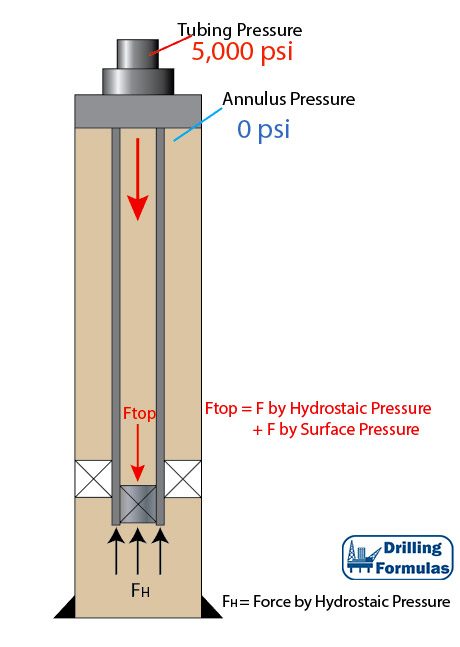
Figure 1 - Wellbore Schematic

Figure 1 – Wellbore Schematic

Continue reading

Piston Force on Open-Ended Tubular

Piston force is a load caused directly by changes in pressure acting on the exposed cross sectional area of pipe. This results in changing in length of tubular and force acting against tubular. In this article, it generally demonstrates force distribution based on a simple tubular diagram.

Piston-Force-on-Open-Ended-Tubular

Tubing Detail

  • 5” Tubing
  • ID of tubing = 3.696”
  • Weight per length = 17.7 lb/ft
  • Total Length = 10,000 ft
  • Fluid density = 10 ppg
  • Tubing is free to move in the packer
  • Applied surface pressure = 5,000 psi

Continue reading

Buoyancy Effect on Weight of Tubular Submersed in Fluid

When a tubular submerses into drilling fluid or completion fluid, it will affect how the force distribution works on the tubular. This article will describe how buoyancy will affect tubular weight and a location of neutral axial load (zero axial load).

Weight of Tubing in Air

When tubing is hung in the air, the string weight is equal to linear weight per foot multiplied by the total length of the string. The maximum tensile load is on surface and the zero axial load point is at the bottom.

Tubing Detail

  • 5” Tubing
  • Weight per length = 17.7 lb/ft
  • Total Length = 10,000 ft

Total weight = 17.7 x 10,000 = 177,000 lb

Weight at the bottom of tubing is 0 and weight on top is 177,000 lb in tensile.

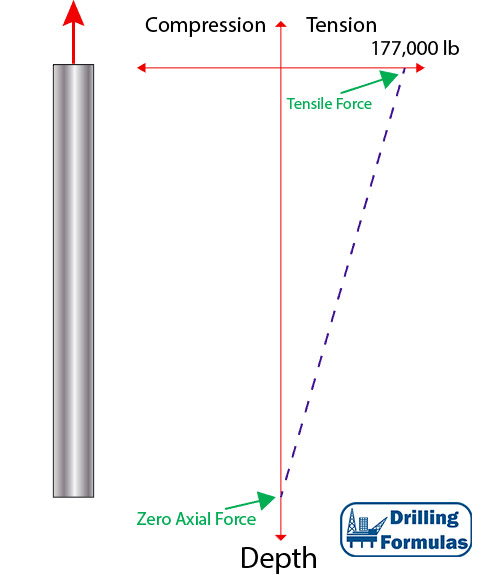
Figure 1 demonstrates force distribution of tubing hanging in air.

Figure 1 - Weight of Tubing in Air

Figure 1 – Weight of Tubing in Air

Weight of Tubing When Submersed in Fluid Continue reading

Oil & Gas Well Casing – VDO Training

There are several articles discussing about casing design and we would like to share you this excellent VDO training in this topic “Oil & Gas Well Casing”. This VDO contains the basic over view of casing starting from surface to production section.  You will see nice illustrations which help you get clearer picture on this topic and we also add full VDO transcripts to provide assistance to some learners who cannot catch the content in this VDO clearly.

Oil & Gas Well Casing – VDO Transcript

oil-Gas-Well-Casing

By the time the crew drills the well to depth, it usually has several strings of casing in it. These strings are called conductor casing, surface casing, intermediate casing and production casing.

Notice that cased well looks something like a telescope pulled out of full-length but it is as the crew drills the well deeper, the size of the whole and the size of the casing gets smaller in diameter. Almost always, the drilling contractor cannot begin drilling at the surface and go all the way to total depth in one step.

Continue reading